Cuyahoga Valley doesn't get the crowds of Zion or the Smokies, and I think that's mostly a function of nobody expecting a real national park to be sitting right between Cleveland and Akron. It doesn't have the scale of the West's big parks, and it shouldn't try to — what it has instead is waterfalls, a genuinely interesting stretch of preserved canal history, and enough variety packed into a compact footprint that a single well-planned day covers most of it. Here's my real list.
Best Time of Year to Visit, and Why
I'd go in late April through June, or September and especially October. Spring brings wildflowers and full-flow waterfalls after snowmelt and rain. But if I had to pick one window, it's fall — peak color usually lands around the third week of October, when the sugar and red maples turn first, followed by oaks holding their color even into late October, especially around The Ledges. Summer is fine and the park doesn't get brutally hot the way a desert park does, but it's also the buggiest and most humid stretch, and the waterfalls tend to run lower without recent rain. Winter is quiet and genuinely pretty with snow on the Ledges, but some trail surfaces get icy and a few amenities scale back.
How Cuyahoga Valley Compares to Indiana Dunes
I get asked about these two together more than you'd think, since they're both "surprise" national parks sitting close to a major metro rather than out in the wilderness. Here's my honest comparison:
| Cuyahoga Valley | Indiana Dunes | |
|---|---|---|
| Terrain | Wooded river valley, waterfalls, sandstone ledges | Lake Michigan shoreline, sand dunes, beach and wetland |
| Signature feature | Brandywine Falls | The dunes themselves, plus West Beach |
| Nearest metro | Cleveland / Akron, OH — both under 45 min | Chicago, IL — about an hour |
| Best for | A fall-color hiking day, or a shoulder-season weekend | A summer beach day near the city |
| Entrance fee | Free, no gate, open year-round | Paid entrance (day-use fee applies once you stop to use a trail or beach) |
If I had to pick one, I'd pick based on the season: Cuyahoga Valley in October, Indiana Dunes in July. They're different enough experiences that I don't think you're really choosing between them so much as choosing which one matches your calendar.
Day-Trip Checklist — Cuyahoga Valley National Park
This isn't a wilderness park, so you don't need serious backcountry gear — but a few things make the day noticeably better:
- A bike, if you have one — the Towpath Trail is flat, wide, crushed limestone for nearly 20 miles through the park, and it's genuinely one of the best easy bike rides I've done near any city.
- Real trail shoes with some grip — The Ledges has narrow rock passages and can be slick after rain, even though nothing here requires technical footwear.
- A refillable water bottle — there's tree cover on almost every trail, so heat is less of an issue than at a desert park, but I still went through more water than I expected on the longer loops.
- Bug spray in warmer months — the trails near the river and wetlands get mosquitoes, especially at dawn and dusk in summer.
- Cash or a card for the Scenic Railroad — if you want to try the train-plus-bike combo along the Towpath, it's a small one-way fee per person, separate from anything else in the park.
- A camera with a slow-shutter mode — Brandywine and Blue Hen Falls both photograph noticeably better with a longer exposure than a quick phone snap.
The 10 Best Things to Do in Cuyahoga Valley National Park
-
1. Brandywine Falls Trail
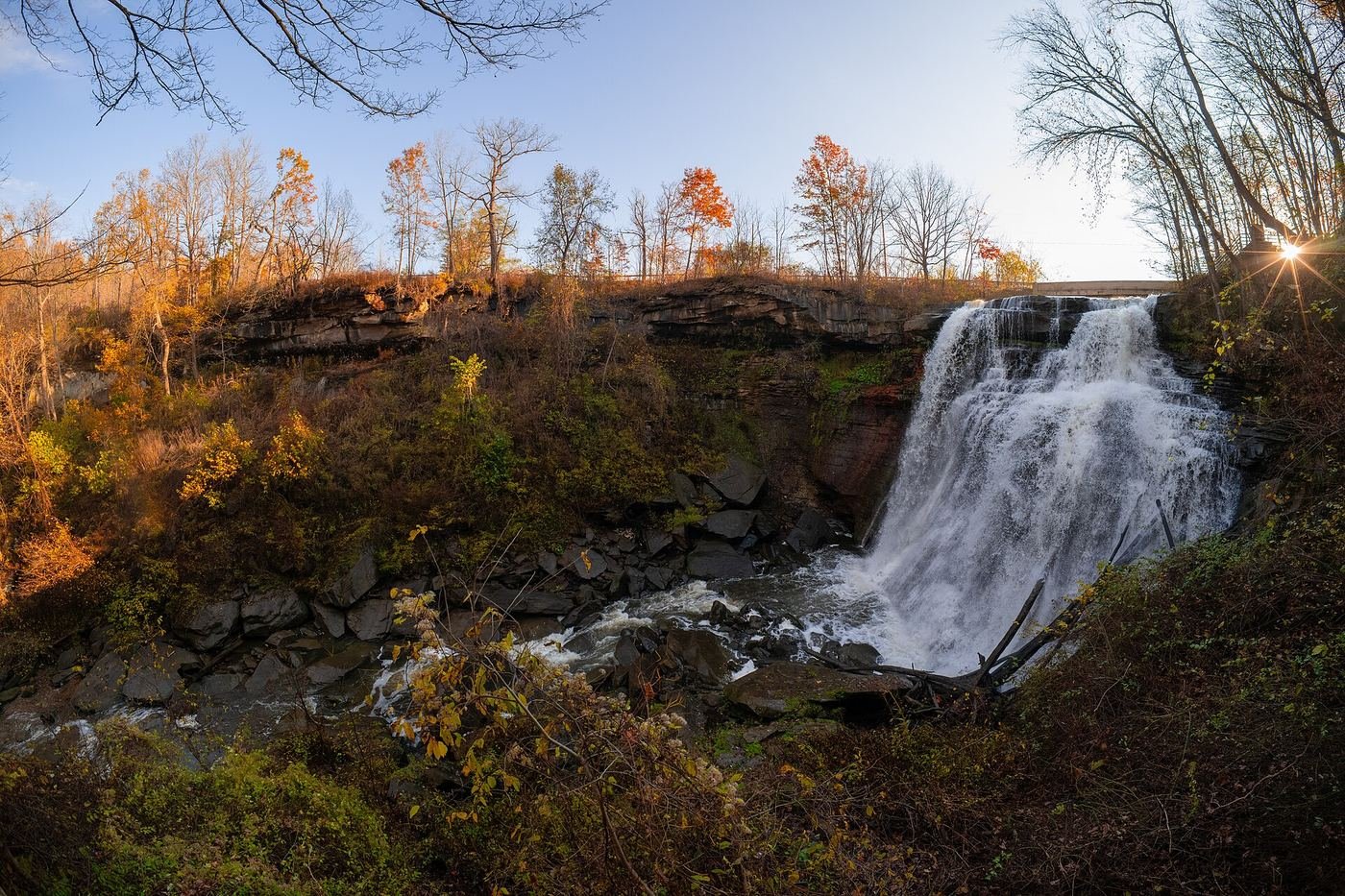
The park's icon — a 60-foot waterfall reached by a short, wide, ADA-accessible boardwalk to an upper platform, with a steeper lower deck (about 80 steps) for a closer view. 0.6 mi RT, easy, ~30 min.
-
2. The Ledges Trail
A loop through house-sized sandstone outcrops at Ritchie Ledges, with narrow passages and a wide overlook near the end. Passes Ice Box Cave, which is gated and closed to protect bats from white-nose syndrome — worth a look from outside, not from in. 2.2 mi loop, moderate, ~1.5 hrs.
-
3. Ohio & Erie Canal Towpath Trail
Flat, crushed-limestone path along the old canal mule road, walkable or bikeable in any segment you like. Pair it with the Scenic Railroad's Explorer Program to ride one direction and take the train back. 19.5 mi total, easy, walk any segment.
-
4. Blue Hen & Buttermilk Falls Trail
A quieter alternative to Brandywine — Blue Hen Falls alone is a quick 0.5-mile round trip, or continue on to Buttermilk Falls for a longer, much less crowded version of the same waterfall-hike experience. 3 mi RT, moderate, 1.5–2 hrs.
-
5. Brandywine Gorge Loop
The longer loop version of the Brandywine Falls hike, following the gorge below the falls rather than just the boardwalk out and back. A good way to extend your time at the park's best-known spot. 1.4 mi loop, moderate, ~1 hr.
-
6. Salt Run Trail
A quieter loop through second-growth forest in the southern part of the park — I'd send anyone here who wants a real hike without the Brandywine or Ledges crowds. 3.25 mi loop, moderate, 1.5–2 hrs.
-
7. Old Carriage Trail
A longer, rolling hike through the Hunt Farm and Farm Field areas — a good pick if you want more distance without technical terrain. 5.25 mi, moderate, 2.5–3 hrs.
-
8. Riding Run Loop
A solid full loop near the Pine Hollow area, wooded and quiet, good for a longer afternoon if you've already done the headline trails. 5.6 mi loop, moderate, 2.5–3 hrs.
-
9. Furnace Run Loop
A shorter loop near the park's eastern edge that's easy to underestimate — nice creek-side stretches and a good option if you want something in between Brandywine's crowds and a full half-day hike. 1.9 mi loop, easy-moderate, ~1 hr.
-
10. Buckeye Trail (Cuyahoga Valley segments)
The Buckeye Trail is a 1,400-mile route that circles the entire state of Ohio, and roughly 33 miles of it pass through this park. You obviously don't need to hike all of it — but picking a segment near one of the waterfalls is a good way to see a piece of a genuinely historic long-distance trail without committing to more than an afternoon.
Build Your Cuyahoga Valley Trip, Free
I built ParkPlan to turn a list like this into a real day-by-day itinerary with your own dates, travelers, and budget.
Start My Cuyahoga Valley Trip → Or see my full Cuyahoga Valley day-trip itineraryNearby Parks to Pair With Cuyahoga Valley
Building a longer road trip? These guides sit within a day's drive of this one.
Trail stats, access details, and closures are accurate as of publication but change — always confirm current conditions at nps.gov/cuva before you go.