Glacier is a park almost everyone underestimates before they go — it's not a quick add-on to a bigger Montana trip, it's a destination that deserves its own dedicated week if you can give it one. Most first-time visitors do Going-to-the-Sun Road and one hike near Logan Pass and call it done. That's a good start, but it's maybe a third of what's actually here. Here's my real list, plus the planning details that change how good your trip actually is.
Best Time of Year to Visit, and Why
Realistically, your window is July through early September, and that's not a preference — it's mostly a function of the road. Going-to-the-Sun Road usually doesn't clear to its full length until mid-to-late June, and it closes for the season around the third week of October, both dates moving year to year with snowfall. That means the alpine trails at Logan Pass — Hidden Lake Overlook, the Highline Trail — are really only reachable for about three or four months. Early in that window (late June, early July) you'll still find snowfields on the higher trails and cooler temperatures; by August, the meltwater feeding the waterfalls has usually dropped noticeably. I'd lean toward July if I had to pick one month — better trail conditions than June, less smoke risk than a bad August wildfire season, though that's never guaranteed in the Northern Rockies.
How Glacier Compares to Yellowstone
These two get compared constantly since they're both huge Rocky Mountain parks with a short predictable season, so here's my honest take rather than a dodge:
| Glacier | Yellowstone | |
|---|---|---|
| Signature feature | Jagged glacially-carved peaks, alpine lakes, one epic road | Geysers, hot springs, and the largest concentration of wildlife in the lower 48 |
| Best for | Serious hikers who want real alpine terrain and don't mind exposure | First-time visitors, families, and anyone who wants geothermal features you can't see anywhere else |
| Access season | Short — the main road is only fully open a few months a year | Longer — most of the park's main loop stays open into fall, and parts operate in winter |
| Wildlife | High grizzly density; bear spray is a real, not optional, consideration | Bison, wolves, elk, and bears, mostly viewed from pullouts along the road |
| Size | About 1 million acres | About 2.2 million acres, spread across three states |
If I had to pick just one, I'd pick Yellowstone for a first national park trip and Glacier for the hiking — but they're close enough together that a lot of people do both in the same two-week loop through Montana and Wyoming, and I think that's the better answer if you have the time.
Hiking Checklist — Glacier National Park
Glacier's biggest gear difference from most parks I've written up is bear country and real alpine weather, not heat. Here's what I actually bring on every hike here:
- EPA-registered bear spray, worn on a hip or chest holster — not buried in your pack. Glacier has one of the densest grizzly populations in the lower 48, and spray in a pack you can't reach in three seconds isn't much use.
- Layers, including a real insulating layer — Logan Pass sits around 6,600 feet and the weather can turn fast even in July; I've been rained and hailed on there in short sleeves within the same hour.
- A packable rain shell — afternoon storms build quickly over the Divide.
- Real hiking boots with ankle support — several of the best trails here (Highline especially) have exposed, uneven, sometimes loose footing.
- A 2–3L hydration reservoir — the alpine trails have long shadeless stretches despite the cooler air temperature.
- A whistle or a habit of talking/clapping on blind corners — noise is one of the simplest, most effective ways to avoid a surprise bear encounter.
- A printed or downloaded shuttle schedule — cell service is unreliable to nonexistent through most of the park, and you don't want to be guessing about your ride back.
The 10 Best Things to Do in Glacier National Park
-
1. Drive Going-to-the-Sun Road, Start to Finish
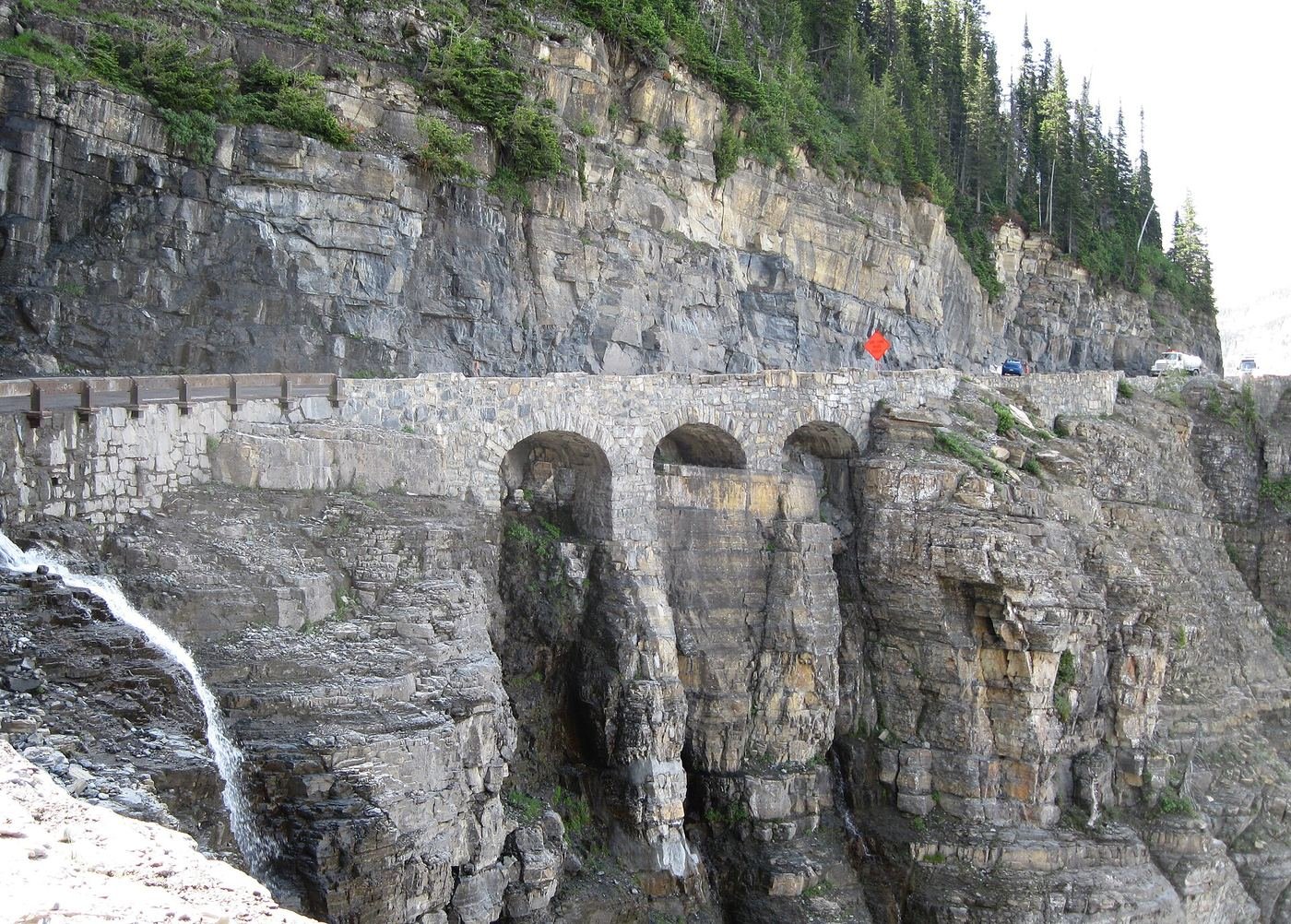
Even if you don't hike a step, this 50-mile road over Logan Pass is the single best introduction to the park — glacial lake, cedar forest, and an exposed cliffside climb up the Garden Wall to the Continental Divide. Only fully open roughly mid-June through mid-October, weather permitting. Easy, 2–3 hrs plus stops.
-
2. Hike the Highline Trail to Granite Park Chalet
The park's headline hike — a narrow, cable-assisted ledge along the Garden Wall giving way to rolling alpine meadow, ending at a historic backcountry chalet. As of 2026 you'll need a Logan Pass shuttle reservation to reach the trailhead and get back, since Logan Pass parking is capped at 3 hours in peak season. 11.6 mi one-way with a shuttle back, ~1,410 ft gain, strenuous, 6–8 hrs.
-
3. Hidden Lake Overlook
The best short hike in the park for the effort it asks — a boardwalk climb from the Logan Pass Visitor Center through meadows where mountain goats are a near-guarantee, ending at an overlook of Hidden Lake below Bearhat Mountain. 2.8 mi RT, ~550 ft gain, moderate, 1.5–2 hrs.
-
4. Grinnell Glacier Trail, Many Glacier
My pick for the single best hike in the park if you only get to do one big one. It climbs past Grinnell Lake toward the retreating Grinnell Glacier itself — one of the more accessible ways left to see actual glacial ice up close. Many Glacier is also some of the densest grizzly habitat in the park, so hike with a group and carry bear spray. 10.6 mi RT, ~1,600 ft gain, strenuous, 7–9 hrs.
-
5. Iceberg Lake Trail
The other headline hike out of Many Glacier, ending at a lake that holds actual icebergs calved from the surrounding cliffs well into summer in a good snow year. A real alternative to Grinnell Glacier if you want something slightly shorter or the day's already spoken for. 9.6 mi RT, ~1,200 ft gain, strenuous, 6–7 hrs.
-
6. Avalanche Lake Trail
The honest, more achievable alternative to the Highline — a forested climb of a few hundred feet from the Trail of the Cedars trailhead to a lake ringed by hanging valleys and waterfalls on the far wall. 4.6 mi RT, moderate, 2–3 hrs.
-
7. Two Medicine
The side of the park most people skip entirely, which is exactly the appeal — noticeably quieter than Many Glacier or Logan Pass even at the height of summer. Running Eagle Falls (sometimes called Trick Falls) is an easy 0.6-mile round trip, Twin Falls is a moderate 7-mile round trip often paired with a boat shuttle, and Scenic Point climbs to a huge valley view for those with legs left.
-
8. St. Mary & Virginia Falls Trail
An east-side trail near St. Mary Lake leading to a pair of waterfalls, with the option to extend further to Baring Falls. A good moderate option on the quieter St. Mary side of the road if the west-side trailheads are packed. 3.1 mi RT, moderate, 1.5–2 hrs.
-
9. Trail of the Cedars
A fully accessible, mostly boardwalk loop through old-growth cedar and hemlock near Avalanche Creek — a completely different ecosystem than the alpine tundra at Logan Pass, and an easy add to any day on the west side. 0.9 mi loop, easy, 20–30 min.
-
10. Apgar Lookout
A steady, sustained climb from near West Glacier to a historic fire lookout with a sweeping view over Lake McDonald and the Middle Fork Flathead valley — a good pick for a west-side day when the Logan Pass shuttle is booked up. 7.2 mi RT, roughly 1,800–1,900 ft gain depending on the source, strenuous, 3–4 hrs.
Build Your Glacier Trip, Free
I built ParkPlan to turn a list like this into a real day-by-day itinerary with your own dates, travelers, and budget.
Start My Glacier Trip → Or see my full 1, 2 & 4-day Glacier itineraryNearby Parks to Pair With Glacier
Building a longer road trip? These guides sit within a day's drive of this one.
Trail stats, shuttle rules, and road-opening dates are accurate as of publication but change every season — always confirm current conditions at nps.gov/glac before you go.