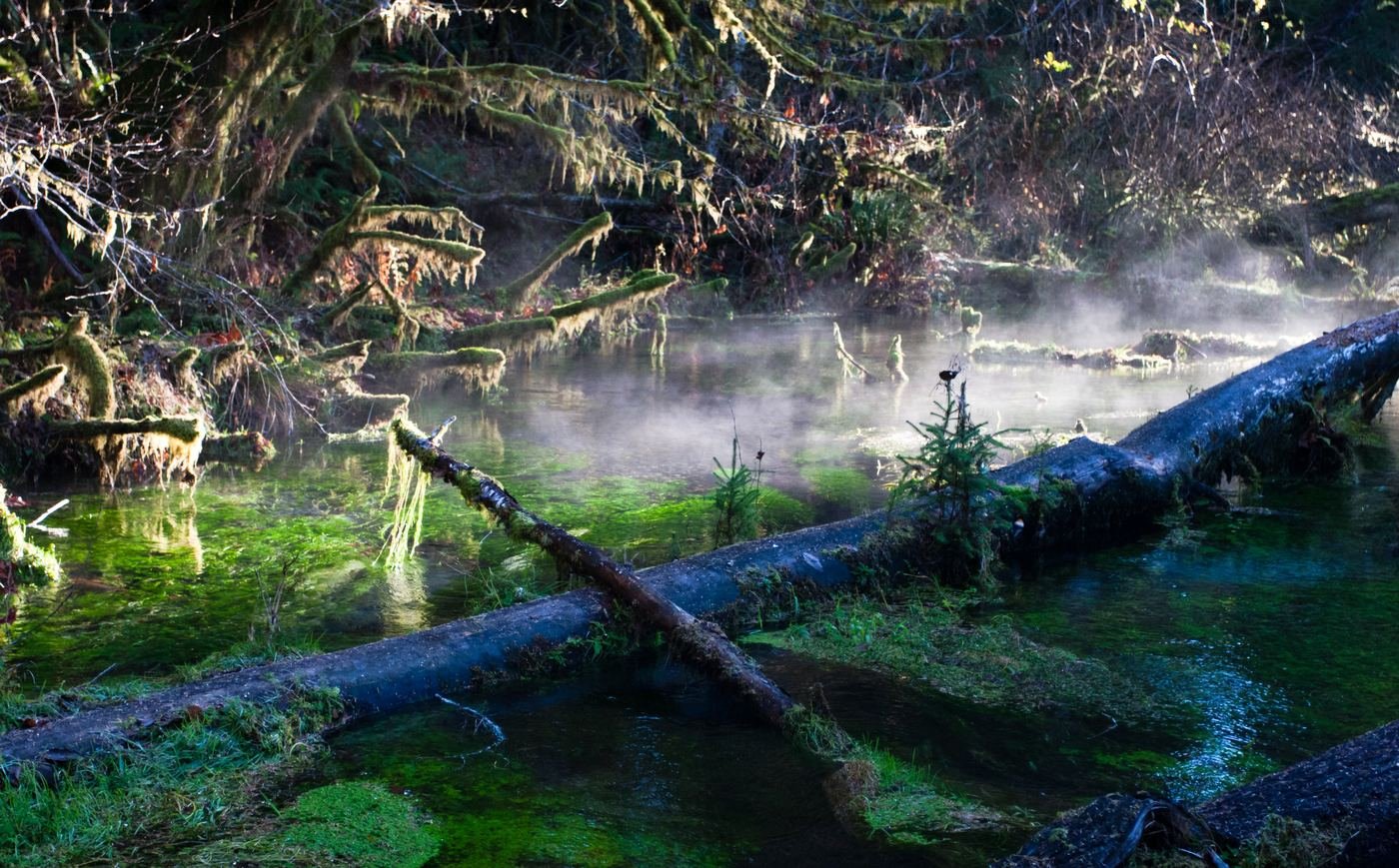
Olympic pulled in roughly 2.9 million recreation visits in 2023, making it one of the ten most-visited parks in the country, and I think most of those visitors only see one of its three faces before they leave. That's the thing I'd tell anyone going for the first time: this isn't one park, it's a rainforest, a coastline, and an alpine range that happen to share a boundary line. Here's my real list, plus the planning details that actually change how good your trip is.
Best Time of Year to Visit, and Why
I'd go July through September, and here's my honest reasoning rather than a repeated rule of thumb: this is the wettest place I've hiked in the Lower 48, and the difference between visiting in summer and any other season isn't subtle. The Hoh Rainforest gets around 140 inches of rain a year, and most of it falls outside the summer months — I've talked to people who did the coast in a spring downpour and never saw past the nearest sea stack. Hurricane Ridge Road is only open Friday through Sunday in winter and can be snow-covered even into early summer some years, so the alpine third of the park is genuinely inaccessible outside the warm season. Summer also brings the best odds of the clear days you actually want for the Hurricane Ridge views. The tradeoff is crowds — July and August are Olympic's busiest months by far, especially at the coast trailheads and in the Hoh's small parking lots, so I'd still aim to start early regardless of season.
How Olympic Compares to North Cascades
I get asked whether someone should do Olympic or North Cascades if they're picking one Washington park, so here's my honest comparison rather than a dodge:
| Olympic | North Cascades | |
|---|---|---|
| Terrain | Rainforest, alpine ridge, and Pacific coast all in one park | Glaciated, jagged peaks — over 300 glaciers |
| Access | A 330-mile ring road (US-101) connects every region | A single paved road, closed roughly October–April |
| Crowds | Nearly 3 million visitors a year | Only 20,000–30,000 visitors a year — genuinely quiet |
| Trail character | More variety, more easy-to-moderate trails close to the road | Rugged, backcountry-focused, less forgiving for casual hikers |
| Best for | Maximum variety in one trip — rainforest, ocean, and mountains | Solitude and serious backcountry hiking |
If I had to pick just one, I'd pick Olympic for variety and accessibility — it rewards a first-time visitor much faster than North Cascades does. I'd pick North Cascades only if crowds are your dealbreaker and you're comfortable in genuine backcountry with far fewer services around you.
Hiking Checklist — Olympic National Park
This is rain-forest and coastal terrain, which means my kit here looks almost nothing like what I'd pack for a desert park — the risk isn't heat, it's staying dry and warm in conditions that can turn wet fast, any month of the year. Here's what I actually bring on every hike in Olympic:
- A real waterproof rain shell, not water-resistant — this is the single most important item in the park, in any season, even on a forecast that looks clear.
- Waterproof or quick-drying footwear — rainforest trails stay muddy well into summer, and coastal trails cross wet sand and tidal rock.
- A tide table or tide app for any coastal hike — several beach routes, including Rialto Beach to Hole-in-the-Wall, become impassable above certain tide heights.
- Layers you can add and remove quickly — temperatures swing more than you'd expect moving between the coast, the rainforest, and the alpine zone in the same trip.
- A dry bag or waterproof stuff sack for electronics — I learned this one the hard way on a "light drizzle" that turned into a real downpour on the Hoh River Trail.
- A paper map or downloaded offline map for Hurricane Ridge and the coast — cell service is unreliable to nonexistent across most of the park.
- Trekking poles — genuinely useful on slick rainforest roots and uneven beach cobble alike.
The 10 Best Things to Do in Olympic National Park
-
1. Walk the Hall of Mosses
The single most iconic stretch of the Hoh Rainforest — a short, easy loop through bigleaf maples so heavily draped in club moss they look upholstered. No permit needed for day hiking, just the standard entrance fee. 0.8 mi loop, easy, 30–45 min.
-
2. Hike Into the Hoh River Trail
The approach trail toward Blue Glacier and Mount Olympus for backpackers, but a great out-and-back for day hikers too — you don't need to reach Five Mile Island to get the quieter, wilder side of the rainforest along the river. 10 mi RT to Five Mile Island, moderate, 5–7 hrs.
-
3. Walk Rialto Beach to Hole-in-the-Wall
Flat beach walking past sea stacks to a sea arch you can pass through at low tide. Check a tide table first — some headlands are impassable above roughly a 5-foot tide. 3.0 mi RT, moderate, 2–3 hrs.
-
4. Hike Hurricane Hill
The best view-to-effort ratio in the alpine zone — a paved-then-gravel climb through subalpine meadow to a summit view spanning the interior Olympic Mountains and the Strait of Juan de Fuca. 3.2 mi RT, moderate, 1.5–2.5 hrs.
-
5. Walk Second Beach for the Classic Coast Photo
A short forested approach drops onto a wide beach with some of the most photogenic sea stacks on the peninsula — the easiest way to get a real coastal payoff without a big time commitment. 1.4 mi RT, easy, 1–1.5 hrs.
-
6. Soak at Sol Duc Hot Springs
A developed hot springs resort with mineral pools fed by the Sol Duc River valley, open on a seasonal schedule roughly March through October. I'd pair it with the nearby Sol Duc Falls Trail — a short, easy 1.6-mile round trip to a striking three-way waterfall — for a full afternoon in that part of the park.
-
7. Hike (Carefully) to the Mount Storm King Viewpoint
A steep climb above Lake Crescent that ends, for most hikers, at the "End of Maintained Trail" sign with a railed view already worth the climb. The final push beyond it is an unmaintained rope scramble on an exposed ridge — genuinely dangerous, and not something I'd recommend to anyone without real scrambling experience. 4.0 mi RT, strenuous, 3–5 hrs.
-
8. Backpack or Day Hike the Ozette Triangle
A 9.4-mile loop connecting two remote beaches, Cape Alava and Sand Point, by boardwalk trail on either end and beach walking in between — one of the least-crowded ways to experience the coast. Check tide tables for the beach section, and get a wilderness permit through Recreation.gov in advance if you plan to camp overnight on the beach. 9.4 mi loop, moderate, 6–8 hrs as a day hike.
-
9. Walk to Marymere Falls
A short, shaded old-growth forest walk near Lake Crescent to a 90-foot falls dropping into a narrow, mossy gorge — an easy add if you're already in the area for Mount Storm King or the lake itself. 1.8 mi RT, easy, 1–1.5 hrs.
-
10. Drive the Loop Between Regions and Stop at Ruby Beach
If you only have time for one coastal stop and don't want to commit to a longer hike, Ruby Beach is a very short walk down to sea stacks and a scattering of sea-polished logs, right off Highway 101 — an easy way to see the coast even on a tight schedule. ~0.5 mi RT, easy, 15–20 min.
Build Your Olympic Trip, Free
I built ParkPlan to turn a list like this into a real day-by-day itinerary with your own dates, travelers, and budget.
Start My Olympic Trip → Or see my full 1, 2 & 3-day Olympic itineraryNearby Parks to Pair With Olympic
Building a longer road trip? These guides sit within a day's drive of this one.
Trail stats, tide dependencies, and closures are accurate as of publication but change — always confirm current conditions, road status, and tide tables at nps.gov/olym before you go.