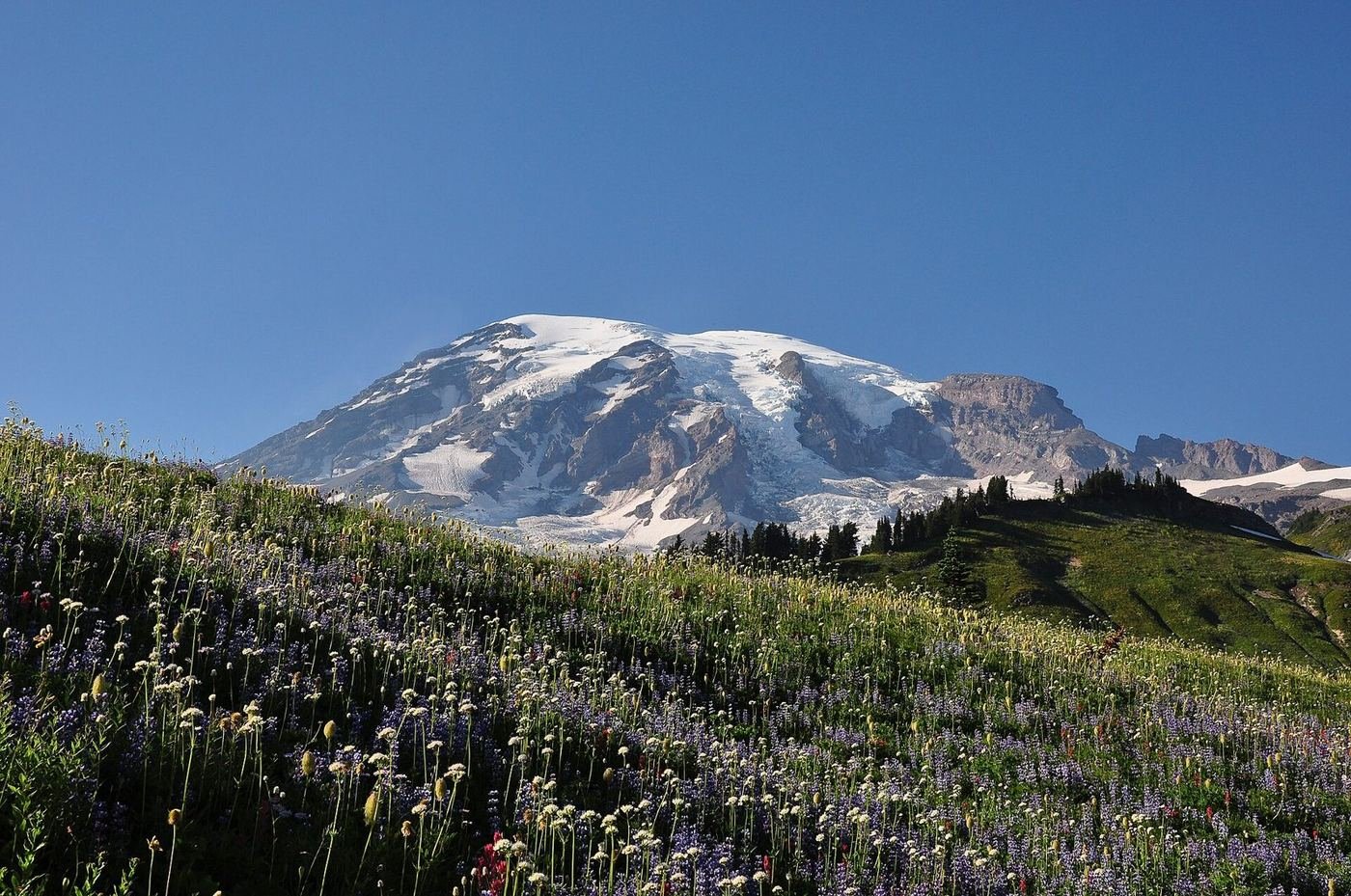
Mount Rainier is the most heavily glaciated peak in the contiguous United States and one of the most dramatic mountains in the country. It's a very different park depending on which side you visit, and the weather decides everything. This is how I'd rank what's worth doing.
Best Time of Year to Visit, and Why
I'd go from mid-July through September. That's when the high-country trails are snow-free, the roads to Paradise and Sunrise are open, and the wildflowers are in bloom — late July to mid-August is the peak. August is the busiest month, and September is quieter with a better chance of clear skies and fall color.
Earlier in the season, snow can still cover the upper trails, and in winter only the road to Paradise stays open (with chains required), but snowshoeing at Paradise is a great experience if you're ready for it.
How Mount Rainier Compares to Olympic
They're both big Washington parks, so here's how I'd choose.
| Mount Rainier | Olympic | |
|---|---|---|
| Headline | A 14,411-foot glaciated volcano | Rainforest, coast, and mountains in one park |
| Hiking | Alpine meadows and glaciers | More variety — beach walks to rainforest trails |
| Crowds | Heavy in summer at Paradise and Sunrise | Spread across several regions |
| Best time | Jul–Sep | Jul–Sep |
| Best for | Mountain views and wildflowers | Variety and wild coast |
If I could only pick one, I'd choose Mount Rainier for the mountain itself and the meadows, and Olympic for variety. Rainier is better if you want one iconic place to hike; Olympic is better for a longer road trip.
Hiking Checklist — Mount Rainier National Park
This is an alpine park with unpredictable weather, so my kit is about layers and the ability to turn around:
- A waterproof shell and warm layers — weather changes fast and temperatures drop quickly at 5,000+ feet.
- Trekking poles — the trails are steep and can have snow patches into July.
- Sun protection — the high-elevation sun is intense, and snow reflects it.
- Sturdy hiking boots — trails are rocky and often wet.
- Insect repellent — mosquitoes are bad in the meadows in July.
- A full tank of gas — there is no fuel inside the park.
The 10 Best Things to Do in Mount Rainier National Park
-
1. Hike the Skyline Trail at Paradise
A steep loop through wildflower meadows with views of glaciers and the Tatoosh Range. The signature hike of the park. 5.5 mi loop, strenuous, 4–5 hrs.
-
2. Walk Nisqually Vista Trail
An easy loop from Jackson Visitor Center with a view of the Nisqually Glacier. 1.2 mi loop, easy, 45 min.
-
3. Visit Reflection Lakes
A pair of lakes that mirror the mountain on a calm morning. Roadside, 20–30 min.
-
4. Hike to Comet Falls
A moderate trail to a 320-foot waterfall — a good option when the summit is in clouds. 3.8 mi RT, moderate, 3 hrs.
-
5. Drive to Sunrise
The highest point you can reach by road at about 6,400 feet, with a different, quieter view of the mountain. Typically open July through September.
-
6. Hike to Mount Fremont Lookout
A historic fire lookout at about 7,181 feet with a great chance of seeing mountain goats. 5.6 mi RT, moderate, 3.5 hrs.
-
7. Walk Sourdough Ridge to Dege Peak
A steady climb on a ridge with views in both directions. 3.4 mi RT, easy, 2 hrs.
-
8. Explore Longmire
A historic area with a museum, a cabin, and the Trail of the Shadows loop. 0.7 mi loop, easy, 20 min.
-
9. Hike Naches Peak Loop
A scenic loop from Tipsoo Lake with wildflowers and a long view of Rainier. 3.4 mi loop, moderate, 2 hrs.
-
10. Visit Silver Falls
A shaded loop to a waterfall in old-growth forest on the southeast side. 3 mi RT, moderate, 2 hrs.
Build Your Mount Rainier Trip, Free
I built ParkPlan to turn a list like this into a real day-by-day itinerary with your own dates, travelers, and budget.
Start My Mount Rainier Trip → Or see my full 1, 2 & 3-day Mount Rainier itineraryNearby Parks to Pair With Mount Rainier
Building a longer road trip? These guides sit within a day's drive of this one.
Trail stats, snow conditions, and road openings are accurate as of publication but change — always confirm current conditions, road status, and reservation rules at nps.gov/mora before you go.